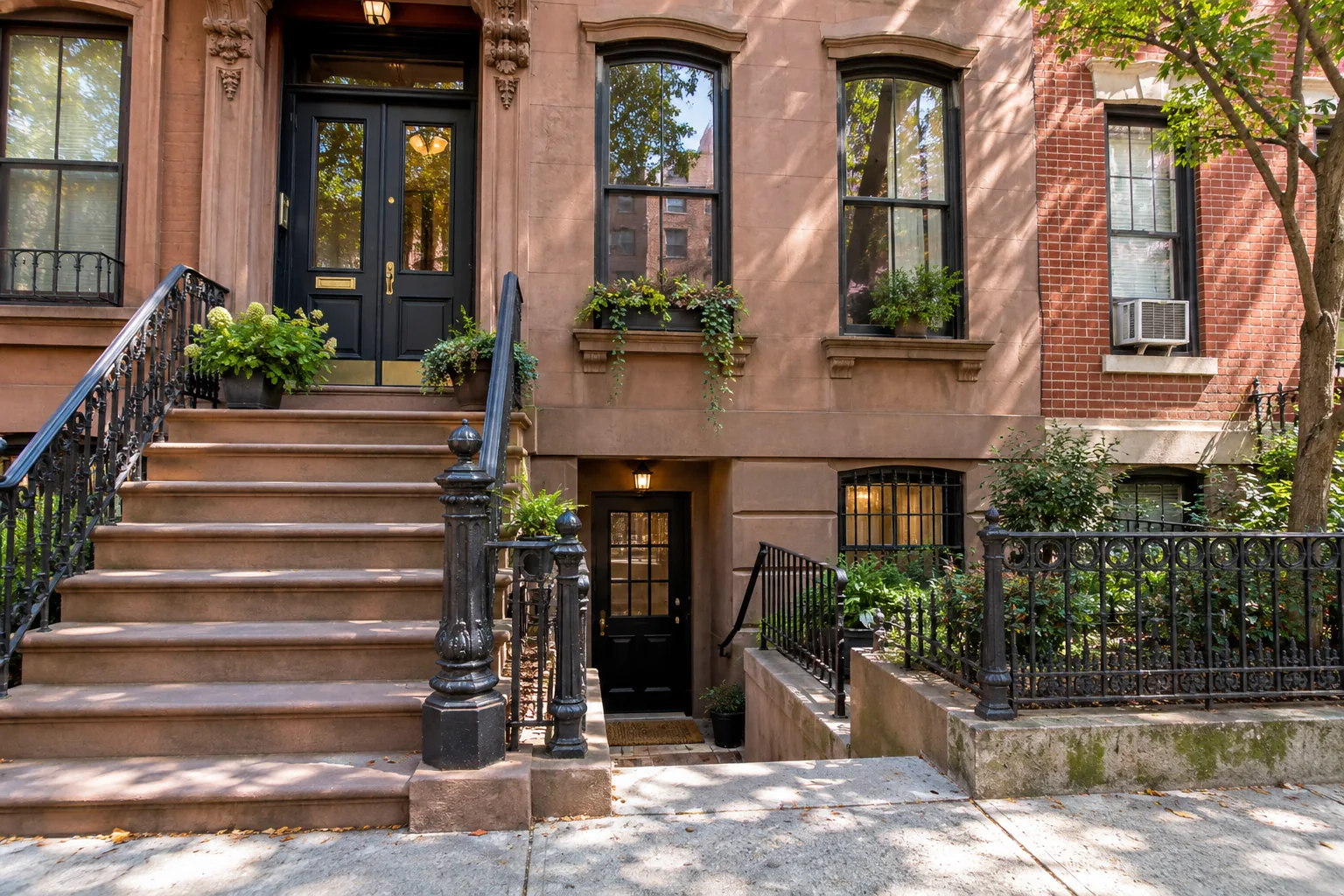
One measurement tells you whether a New York City below-grade apartment is a basement or a cellar: how much of the story sits below the curb outside. Legal occupancy depends on that classification and the other requirements below. More than half of its height below curb level makes it a cellar, and the Housing Maintenance Code bars renting a cellar room in a one- or two-family house unless that room is an ancillary dwelling unit holding a certificate of occupancy. Half or less makes it a basement, which can be occupied and sometimes rented on stated conditions. Listings use both words as synonyms. The code keeps them apart.
The Curb Level Test
Section 27-2004(a)(37) reads: "A cellar in a dwelling is an enclosed space having more than one-half of its height below the curb level. A cellar shall not be counted as a story." Section 27-2004(a)(38) reads: "A basement is a story partly below the curb level but having at least one-half of its height above the curb level. A basement shall be counted as a story." The Multiple Dwelling Law carries the same pair at section 4(37) and 4(38). Curb level is not the ground outside your window: section 27-2004(a)(36) sets it as the level of the curb at the center of the front of the building, averaged across fronts where the building faces more than one street.
Measure the floor-to-ceiling height of the room and find where that curb level falls on the wall. More than half below the line is a cellar; half or more above it is a basement. HPD publishes both definitions word for word. Its webpage still says cellars in one- and two-family homes can never be lawfully rented, but the codified section 27-2087(a)(1) now provides the ancillary dwelling unit exception described below.
| Test you can run in the room | Cellar | Basement |
|---|---|---|
| Share of the room's height below curb level | More than one half | One half or less |
| Counted as a story | No | Yes |
| Renting it in a one- or two-family house | Barred, unless it is an ancillary dwelling unit with a certificate of occupancy | Permitted in a one-family house on conditions |
| Renting it where three or more households live | Only by the adequate adjacent space route in 27-2082 | Permitted where the below-grade article is met |
The Cellar Rental Bar and Its One Exception
For the row house and semi-detached house where this question comes up most, section 27-2087(a)(1) governs: "No room in the cellar of a one- or two-family dwelling shall be rented except for the rental and use of an ancillary dwelling unit," defined in Building Code section U102.1, located in a cellar, and holding a certificate of occupancy or temporary certificate of occupancy. Subdivision (a)(2) reaches the owner's household too, barring any family member from using a cellar room for sleeping, eating or cooking.
Where three or more households live independently, a cellar unit is not barred outright. Section 27-2082 allows one through a route most buildings cannot take: every room needs at least half its height above an "adequate adjacent space," which must be thirty feet in its least dimension, open and unobstructed, and abut the exterior walls at or below floor level. Section 27-2084 adds a path for converted dwellings that needs a yard thirty feet deep at every point and an HPD finding of habitability, and it then deems that cellar a basement for every other purpose in the code.
The Measurements a Basement Unit Has to Meet
Section 27-2081 gates any below-grade unit in a multiple dwelling: none may be occupied unless the cellar or basement is lighted and ventilated to HPD's satisfaction, is free from dampness, is drained, and meets every other requirement the code puts on units above grade.
| Requirement | One- or two-family house | Multiple dwelling erected after 18 April 1929 | Section |
|---|---|---|---|
| Ceiling height | Seven feet in a one-family dwelling | Eight feet if erected after 14 July 1967, nine feet if before | 27-2087(b), 27-2083(a) |
| Ceiling above curb level | No figure; the sill rule governs | Four feet six inches, front room; two feet, rear room, unless the yard is sixty feet or deeper | 27-2083(b) |
| Total window area | One tenth of the floor area, or twelve square feet if greater | One eighth of the floor area, top of each window within one foot of the ceiling | 27-2062(b), 27-2083(e) |
| Openable window area | Forty-five percent of the required area | Half of every required window | 27-2062(b)(3), 27-2058(c)(3) |
| Ground against the window sill | Open space no higher than six inches below the sill | The same six inch rule | 27-2087(c)(3), 27-2082(c) |
| Who may occupy it | One family, boarders excluded (one-family dwelling) | One cellar apartment unless the yard is sixty feet or deeper; five rooms and a bathroom at most | 27-2087(c)(1), 27-2083(f) |
Egress is where guides supply a figure the code does not state. Section 27-2082(e) requires the entire cellar or basement to comply with the Multiple Dwelling Law on fire protection and means of egress, including cellar and basement stairs and cellar entrances, and subdivision (f) counts an occupied cellar as a story for egress.
Checking the Unit From the Records
Two records answer this without involving the landlord. The certificate of occupancy states the permitted use floor by floor, and the lowest floor appears as cellar or basement with a use beside it. HPD says the same, telling renters to check the certificate of occupancy on the DOB website to see if the basement is legal.
The violation record names the problem outright. HPD writes these violations against the sections above, so they are searchable by section number. On 19 October 2026 the Housing Maintenance Code Violations dataset held 11,255 open violations citing sections 27-2081 through 27-2087, across 8,937 buildings. Of those, 8,204 cite section 27-2087, the one- and two-family section, and 3,047 cite section 27-2081. Queens leads the one- and two-family count with 3,444, Brooklyn has 2,896, and Manhattan has nine. All but seventy are written as a class B hazardous violation, and the wording repeats: discontinue use of rooms for living, disconnect the plumbing fixtures, seal the pipe connections at the cellar.
311 carries the complaint side. Between 1 January and 18 October 2026, New Yorkers filed 13,894 complaints under the descriptor for illegal conversion of a residential building or space, up 12.0 percent on the 12,408 in the same window of 2025. Queens accounts for 8,315, or 59.8 percent, against 2,780 in Brooklyn and 827 in Manhattan. The descriptor covers conversions of every kind, so read it as a measure of where neighbors and tenants are filing a 311 complaint. Run the address through the building records lookup first, since both histories attach to the address rather than to the listing.
Checking the Room Itself
The records can be silent while the room answers plainly. Measure the ceiling height, then set the glazed area against the floor area using the figures above. Then look at the sill from the yard: in a one-family basement rental the bottom of the yard or other required open space must be no higher than six inches below the window sill of any required window. An owner who cut new openings or moved walls to make the space work leaves a separate trail in the alteration record.
Consequences of an Illegal Below-Grade Unit
The code puts the duty on the owner. Section 27-2115(b) requires HPD to serve the notice of violation on the owner, the agent or the person responsible for correction, and the violation orders that person to stop the use and seal the plumbing. The civil penalty for a hazardous violation under section 27-2115(a)(2) runs from $75 to $500, plus $25 to $125 for each day from the correction date until the work is done. The code sets no penalty on the person living in the unit.
The instrument that moves people out is a vacate order, a separate document from a violation. HPD states that occupants of illegal basement and cellar apartments may be ordered by the city to vacate, and that an occupant can receive relocation services through HPD if either HPD or DOB issues an order. Read the conditions on that. HPD's orders page says occupants required to leave "may be eligible for relocation services, including, temporary emergency housing," and that this holds whether the unit is legal or illegal. Eligibility is a determination HPD's Emergency Housing Services unit makes case by case, and HPD bills the owner.
Multiple Dwelling Law section 302(1)(b) provides that no rent shall be recovered by the owner for a period in which a dwelling is occupied for human habitation in violation of section 301, and bars an action to recover that rent or a possession proceeding for its non-payment. Two conditions ride on that, and both have to hold. Section 301 requires a certificate before a multiple dwelling may be occupied, and section 27-2004(a)(7) defines a multiple dwelling as the home of three or more families living independently, so a one-family house with a rented basement is a two-family private dwelling that section 301 does not reach. The bar also runs only to the period of unlawful occupation. Confirm the legal class and the certificate before you change what you pay.
Basement Conversions in 2026
City Hall came under pressure after 1 September 2021, when the remnants of Hurricane Ida flooded below-grade units overnight. The city's Extreme Weather Response Task Force report, The New Normal, puts the toll at 13 New Yorkers. The health department's flooding analysis counts 14 Ida-related deaths and attributes 10 of them, 71 percent, to drowning in unregulated basement apartments.
Two separate things came out of the legislation that followed, and most guides conflate them. Local Law 127 of 2024 set the framework for ancillary dwelling units, and DOB opened filings for new ADU construction in DOB NOW on 30 September 2025. Cellar ADUs carry added egress, window and sprinkler requirements, and subgrade ADUs are barred outright in FEMA's Special Flood Hazard Area, the Coastal Flood Risk Area and DEP's 10-Year Rainfall Flood Risk Area.
Legalizing a unit that already exists is the other thing, and it is not open. Local Law 126 of 2024 created a pilot for pre-existing basement and cellar apartments, and DOB's page, read on 19 October 2026, states that pilot applications are not currently being accepted until DOB rules are promulgated; the department held a hearing on proposed rules on 11 December 2025. The pilot will reach fifteen community districts and no others: Bronx 9, 10, 11 and 12; Brooklyn 4, 10, 11 and 17; Manhattan 2, 3, 9, 10, 11 and 12; and Queens 2. The unit must have existed before 20 April 2024, the owner must apply before 20 April 2029, properties in the flood risk zones are excluded, and an accepted unit runs on an Authorization for Temporary Residence with a phased ten year compliance schedule.
An earlier program has closed. HPD's Basement Apartment Conversion Pilot Program covered East New York and Cypress Hills in Brooklyn Community District 5, and HPD is no longer considering applications. A cellar in a two-family house, or a building outside those fifteen districts, has no program to enter.
Frequently Asked Questions
What makes a basement apartment illegal in NYC?
Two separate failures can make it illegal. The space may be a cellar rather than a basement, which bars a rental in a one- or two-family house unless it is an ancillary dwelling unit with a certificate of occupancy. Or it may fail the below-grade conditions in the code: ceiling height, window area, the ground level against the sill, dampness, or the egress rules.
What is the difference between a cellar and a basement in NYC?
The share of the story below curb level. Section 27-2004(a)(37) defines a cellar as an enclosed space having more than one-half of its height below the curb level, and it does not count as a story. A basement, under section 27-2004(a)(38), keeps at least one-half of its height above curb level. Curb level is measured at the center of the frontage.
Can my landlord evict me from an illegal basement apartment?
The illegality belongs to the owner. HPD serves the notice of violation on the owner or the agent under section 27-2115(b), and the code sets no penalty on the occupant. Where three or more households live independently without the certificate Multiple Dwelling Law section 301 requires, section 302(1)(b) bars a possession proceeding for non-payment of rent. A city order to vacate is a separate route that can still require you to leave.
Do I have to pay rent for an illegal basement apartment in NYC?
Multiple Dwelling Law section 302(1)(b) says no rent is recoverable by the owner for a period in which a dwelling is occupied in violation of section 301. Both conditions have to hold first. Section 301 covers multiple dwellings, three or more households living independently, so a rented basement in a one-family house sits outside it, and the bar runs only to the unlawful period.
Can a basement apartment in NYC be legalized?
Not through the Local Law 126 pilot yet. DOB's page said on 19 October 2026 that applications are not being accepted until its rules are promulgated. The pilot will reach fifteen named community districts, units that existed before 20 April 2024, and properties outside the flood risk zones. New construction is separate, and DOB has taken those filings since 30 September 2025.