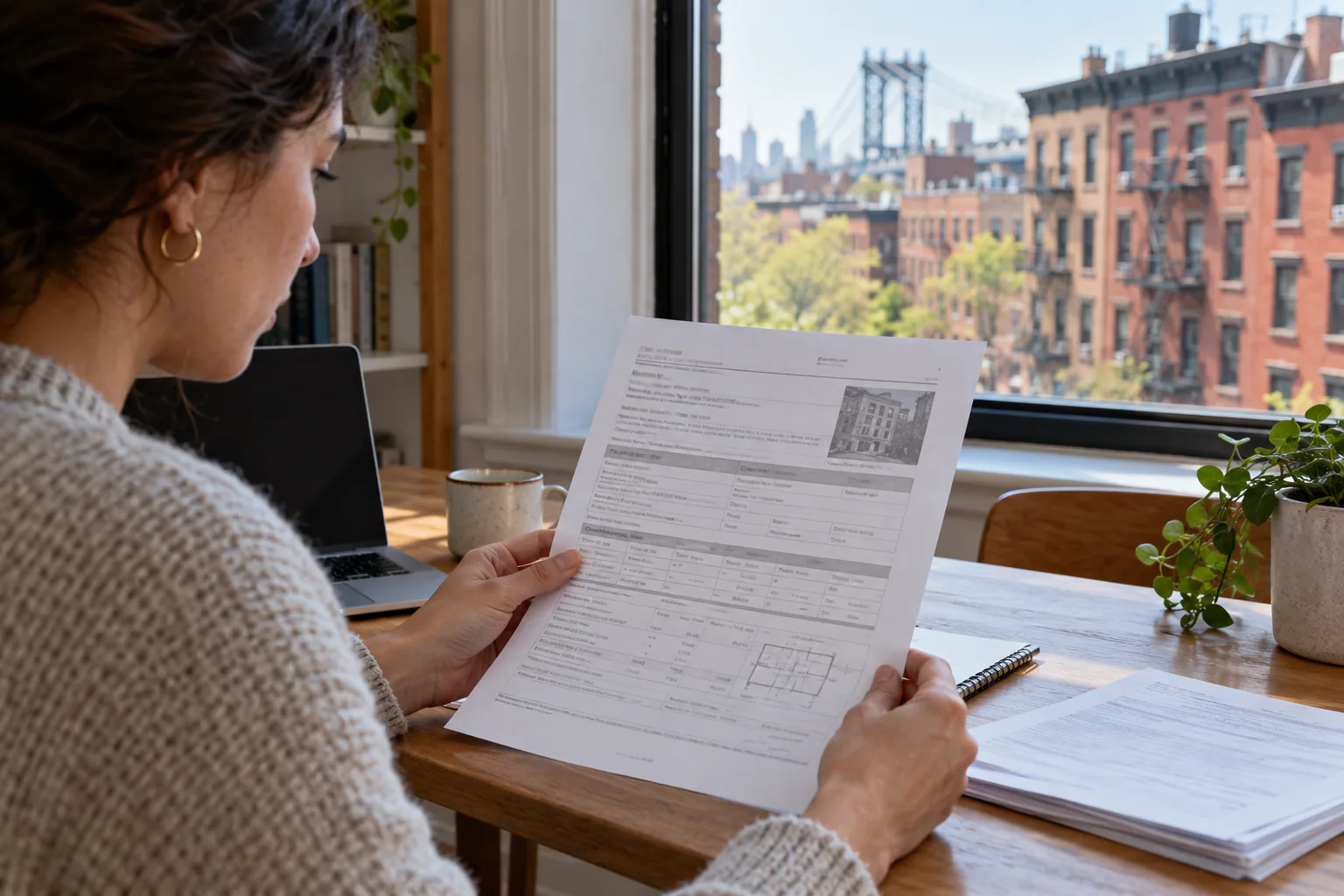
Pull an NYC building's certificate of occupancy free from DOB NOW if it was issued on or after March 1, 2021, and from the Buildings Information System if earlier. The document records the uses and occupancy the city has approved there, which is narrower than it looks.
A certificate says nothing about whether the radiators hold heat or the roof leaks. Administrative Code 28-118.1 is blunt about its limits: issuing one "shall not be construed as an approval of a violation" of the code or other laws.
What the Certificate Records
Administrative Code 28-118.1 bars any building from being used or occupied without a certificate of occupancy issued by the Buildings commissioner, and for a new building 28-118.2 says the certificate attests that it "conforms substantially to the approved construction documents and the provisions of this code and other applicable laws and rules." The subject is conformance with approved plans at one inspection.
Section 28-118.6 lists the contents: use and occupancy under the building code and the zoning resolution, type of construction, design occupant load of floors and spaces, and maximum permissible live loads. The per-floor rows carry the dwelling units approved on each storey.
Where to Pull the Record
DOB splits certificates across two systems by date. For one issued on or after March 1, 2021, use the address search in DOB NOW and open Certificate of Occupancy on the property profile. For anything earlier, use Building Information Search in BIS, where the profile carries a View Certificates of Occupancy link and pending applications sit under Jobs and Filings.
A second copy sits in the building. Administrative Code 28-118.19 requires the owner to post the certificate, including a temporary or interim one, in a public hall, corridor or management office, and 28-118.18 adds that it "shall be available for inspection at the building at all reasonable times."
Buildings That Lawfully Have No Certificate
An empty search result is the most misread outcome here, because much of the city's housing predates the requirement. Administrative Code 28-118.3.5 lets a building in existence prior to January 1, 1938 that was legally used without a certificate carry on without one, provided the use "is not inconsistent with the records of the department" and the use or occupancy classification has not changed.
A Letter of No Objection stands in place of the certificate for those buildings. DOB's guide states that buildings built before 1938 need no certificate "unless later alterations changed their use, exits, or occupancy," and sends an owner needing proof of legal use to the borough office. State law draws its own line, excepting under Multiple Dwelling Law 301 a class B multiple dwelling existing on April 18, 1929, and an old-law tenement or class A multiple dwelling erected after April 12, 1901 and occupied for the two years before January 1, 1909. A blank search on a 1910 walk-up is a prompt to check the year built.
Final, Temporary, Interim and Amended Certificates
| Certificate | What it covers | How long it lasts | What to read it for |
|---|---|---|---|
| Final | The building as built and inspected | No expiry | Whether later work postdates it |
| Temporary | Portions safe to occupy mid-build | A period DOB sets, typically 90 days | Whether it has run out |
| Interim | Named floors of a larger building | Until the final certificate issues | Whether your floor is named |
| Amended | Part of an existing certificate | No expiry | The unit count after the change |
Administrative Code 28-118.15 leaves a temporary certificate's period to the commissioner, and DOB says one typically expires 90 days after issuance. The fixed period is in state law: Multiple Dwelling Law 301(4) allows a temporary certificate "for a period of ninety days or less" and caps renewals at "a total period of two years from the date of its original issuance." Interim certificates run the other way. Section 28-118.15.1.2 says one "shall remain in effect until the issuance of a certificate of occupancy for the building," and 28-118.15.1 closes the option to residential buildings under eight stories or with fewer than four dwelling units.
Living in a Building Running on a Temporary Certificate
Renewal churn is the normal condition of a new NYC building rather than an alarm. We pulled all 83,111 records from the DOB NOW Certificate of Occupancy dataset at NYC Open Data (dataset id pkdm-hqz6, issuance dates March 12, 2021 to October 16, 2026, retrieved October 19, 2026) and took the latest certificate for each of the 24,601 buildings in it. For 18,946 the latest record is final. For 5,651 it is still temporary, and 2,890 of those were issued more than 90 days before we pulled the data. Consecutive temporary filings on a building sit a median 85 days apart. One 146-unit Brooklyn building, BIN 3425101, filed thirteen of them between May 2021 and February 2024 before its final certificate issued.
A temporary certificate in force makes the occupancy lawful, since DOB's position is that nobody may legally occupy a building until it has issued a certificate of occupancy or a temporary one. Most of the exposure on a lapse falls on the owner: DOB's tool kit warns that when a temporary certificate expires unrenewed, "it may be difficult or impossible to buy insurance or sell or refinance the property." What the city's guidance does not address is the tenant's position in that gap.
A Unit Count That Does Not Match
Six dwelling units on the certificate and eight buzzers in the vestibule is a real finding, and until somebody checks why, it is a records discrepancy. A later amended certificate may exist that you have not opened, or two units were combined, or the work was never filed. Administrative Code 28-118.3.2 bars any change "inconsistent with the last issued certificate of occupancy" until the commissioner issues a new one, so trace the gap on the property profile, where later certificates sit beside the job filings that would show a record of illegal alterations.
Whether the unit itself may lawfully be occupied is a separate question with its own test, and the count on the certificate is evidence toward that answer rather than the answer.
Rent and a Missing Certificate
The statutory rent bar here is conditional, and the conditions do most of the work. It sits in the Multiple Dwelling Law, which under section 3 applies to cities of 325,000 or more and under section 4 reaches only a multiple dwelling: three or more families living independently of each other. A two-family house falls outside it. The occupancy must also violate section 301, so the pre-1938 city exemption and the 1929 and 1909 state exceptions can put a building beyond the bar. The bar runs for the period of unlawful occupancy rather than forever. And a judge applies it, which makes it a defense you raise, not a right you take by withholding rent.
Where those conditions hold, the wording is hard. Multiple Dwelling Law 302(1)(b) provides that "No rent shall be recovered by the owner of such premises for said period, and no action or special proceeding shall be maintained therefor, or for possession of said premises for nonpayment of such rent." In Chazon, LLC v Maugenest in June 2012, the Court of Appeals held that a loft owner out of compliance "is not entitled either to collect rent or to evict the tenant."
Civil Court in Kings County read it again on January 27, 2026 in SG and Sons Realty LLC v Noman. An open ECB violation for occupancy contrary to department records had sat on the building since 2014, and the court held the owner "barred from collecting rent while the premises is in violation of the certificate of occupancy," dismissing the nonpayment petition without prejudice. The owner had paid the fine in 2015, and the court noted that payment does not close a violation without a certification of correction accepted by DOB. That decision is trial-level and marked uncorrected, and the judge named contrary cases holding rent payable where the certificate problem does not touch the lawful unit.
Real Property Law 235-bb gets misreported as a second rent bar. It requires an owner of property with three or fewer rental units to give the tenant "conspicuous notice in bold face type" before signing, stating whether a certificate of occupancy, where required, is currently valid. That is a disclosure duty and nothing further.
Where to Take the Finding
DOB owns the certificate, so a complaint that a building's use does not match it belongs to DOB, which takes complaints through 311. HPD enforces the Housing Maintenance Code and conditions inside the apartment, so an HPD complaint about the certificate lands in the wrong agency. The rent question belongs to a Housing Court judge.
None of those forums rehouses anyone quickly. The violation in the Kings County case was placed in 2014 and sat open twelve years later. When DOB moves hard on an unlawful occupancy, the instrument is a vacate order, which empties an apartment rather than repairing it. Before you sign, run the address through our building records lookup, read the certificate against the violation record, and weigh it with the other red flags in a building's data.
Frequently Asked Questions
Does my apartment have a certificate of occupancy?
Certificates go to buildings rather than individual apartments, so the question is whether your building has one and whether its terms cover your floor and unit count. Search the address in DOB NOW for certificates issued on or after March 1, 2021, and in BIS for earlier ones. If nothing returns and the building predates 1938, the absence may be lawful.
What happens if you move in without a certificate of occupancy?
Nothing happens automatically. Administrative Code 28-118.1 bars occupancy without a certificate, and Multiple Dwelling Law 302 can bar an owner from recovering rent for that period, but the bar reaches only multiple dwellings whose occupancy violates section 301, and a judge decides it. At the sharp end DOB issues a vacate order, which removes the occupants.
How long is a temporary certificate of occupancy good for?
Administrative Code 28-118.15 leaves the period to the Buildings commissioner, and DOB says a temporary certificate typically expires 90 days after issuance. For a multiple dwelling, Multiple Dwelling Law 301(4) fixes it: one may issue for ninety days or less, and renewals may not run past two years from original issuance. An interim certificate lasts until the final one issues.
What does a certificate of occupancy tell you?
It gives the use and occupancy the city has approved, the occupancy group and zoning use group, the type of construction, the design occupant load of floors and spaces, the maximum permissible live loads, and the dwelling units permitted on each floor, all listed in Administrative Code 28-118.6. It says nothing about repair, heat or pests.