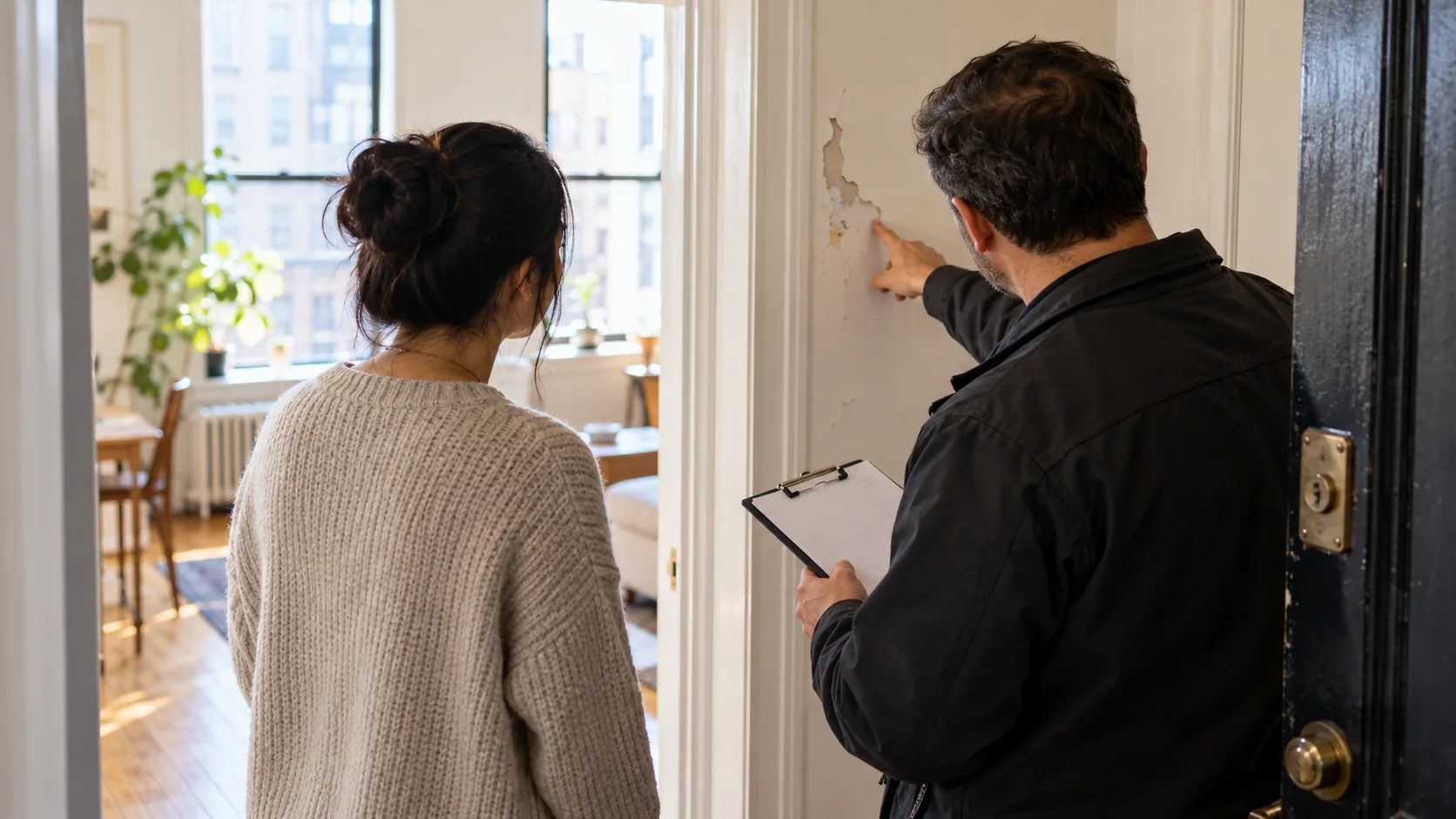
A complaint records what a tenant reported. A violation records what an HPD inspector confirmed in person. In the year to September 22, 2026, New Yorkers filed 898,762 HPD complaints through 311, and HPD issued a violation on 126,544 of them, 14.1%. The other 772,218 closed without one.
That 14.1% is the wrong number to judge a building by, because HPD never ruled on most of what tenants filed. The rate that matters sits underneath it.
The Tenant's Report and the Inspector's Finding
A tenant creates the complaint. The city's Fiscal 2026 management report describes members of the public logging complaints primarily through 311, "which creates a record of housing quality problems reported." 311 does not test the report before it becomes a public record, and your landlord's denial does not remove it. The record says a person called, gave an address and named a condition, and that is the full extent of what it proves. The site has a separate walkthrough of filing one through 311.
An HPD inspector creates the violation, standing in the room. HPD's documentation for the violations file says the agency issues violations against conditions "that have been verified to violate" the New York City Housing Maintenance Code or the New York State Multiple Dwelling Law, and that "Violations are issued by Housing Inspectors after a physical inspection is conducted." Each violation on a building's record carries a hazard class and a correction deadline for the owner.
The two records also carry different legal weight. A 2026 Housing Court decision describes the Housing Maintenance Code as creating "a presumption that violations continue until they are properly corrected and certified," and treats an owner's failure to file a certification as prima facie proof that the condition is still there. HPD takes owners to Housing Court on violations to compel repairs and recover civil penalties. A complaint supports none of that by itself.
Closure Reasons Behind 898,762 Complaints
HPD states its own constraint in one sentence: "Note that HPD must observe a condition in order to issue a violation and may close a complaint if it is unable to observe the condition." That constraint accounts for most of the gap. Grouping all 898,762 complaints by the closure text HPD wrote on each one gives this distribution:
- HPD could not get in, or could not finish the inspection: 250,713 (27.9%)
- HPD inspected and found no violation: 188,198 (20.9%)
- Someone reported the condition fixed before HPD inspected: 132,260 (14.7%)
- HPD inspected and issued a violation: 126,544 (14.1%)
- Duplicate of a building-wide condition already reported: 120,867 (13.5%)
- Closure text points to HPD Online instead of stating an outcome: 32,923 (3.7%)
- Conditions still open, owner notified, access needed: 30,876 (3.4%)
- Condition confirmed, violation already on the record: 9,708 (1.1%)
- Heat not required, outside temperature above 55 degrees: 6,062 (0.7%)
Two of those lines are decisions. HPD inspected and ruled on 314,742 complaints, counting both the ones that produced a violation and the ones where the inspector looked and found nothing against the code. That is 35.0% of the year's filings. Measured against that base, the violation rate is 40.2%. When an HPD inspector gets through the door and looks at the condition, two complaints in five turn into a violation.
The rest closed without a ruling on the condition. The largest group is a visit that failed: 110,202 complaints closed because HPD "attempted to conduct an inspection in response to this complaint, but was unable to complete the inspection," and on another 89,759 the inspector could not get access and left a card at the door. A no-access closure records a missed appointment and settles nothing about the apartment.
The reason renters most expect to see is missing from this file. 311 routes each service request to a responding agency at intake, so a matter HPD does not handle never becomes an HPD complaint and never reaches an HPD closure. Only 305 of the 898,762 closed with administrative language and no stated outcome. When a condition belongs to another agency, the Department of Buildings keeps a separate record of it.
Nine Conditions on Any Inspection
A violation does not have to match the complaint that produced it. HPD tells tenants and owners that "on every inspection, a Housing Inspector will issue violations for the following nine conditions if they exist," and lists lead-based paint hazards where a young child lives in the unit, missing carbon monoxide detectors, missing smoke detectors, missing window guards, apartment or public area doors that do not self-close, illegal window gates, double-cylinder locks, mold and pests.
So a tenant reports a leaking radiator, the inspector arrives, and the building's record gains a violation for a missing smoke detector. Reading a violation list as a summary of tenant complaints will mislead you in both directions.
Heat and Hot Water as the Extreme Case
Heat and hot water accounted for 358,072 complaints, about 40% of the year's total, and produced 14,125 violations. That works out to 3.9 per 100, the lowest rate of any major complaint type, and the reason has little to do with whether the tenants were cold.
115,865 heat complaints closed because an occupant told HPD the heat or hot water had come back by the time the inspector called or arrived. Another 110,247 closed as duplicates, where HPD noted it "may only need to confirm that the condition exists by inspecting one apartment." Twenty tenants in one building report the same dead boiler, the super relights it that evening, and HPD inspects nobody. Across the year, 38,012 heat complaints reached a decision, 10.6% of those filed. A further 6,062 complaints of all types closed because heat was not required when the inspector came, since the daytime duty to hold an apartment at 68 degrees applies when it is below 55 outside during the October 1 to May 31 heat season.
Conditions that stay put produce a different pattern. Peeling paint and plaster produced a violation on 26.2% of complaints, flooring and stairs the same, water leaks 25.4%, unsanitary conditions 23.0%, broken doors and windows 20.9%. The lowest of those rates is five times the heat rate. A heat complaint count measures how often the boiler failed.
Many Complaints and Few Violations
Two buildings can carry the same complaint count for opposite reasons. Of the two patterns, the record to trust least is many complaints with few violations.
Tenants in that building kept reporting conditions, which counts for something on its own; a tenant who calls 311 is reporting something they are living with. Treat the thin violation list as unproven rather than clean, because 65% of complaints citywide close with nobody ruling on the condition, and the commonest reason is that HPD could not get inside. Read the closure reason on each complaint before you draw a conclusion.
A building with both complaints and violations has been measured. An inspector went in, wrote the condition down and started a clock on the owner. You know what was wrong and in which apartment, and you can then ask whether a closed violation was repaired or only certified, which is a harder record to read and a more useful one. The case for real alarm is a long violation list whose serious entries have sat past their correction dates, or a violation that is still open years after it was issued.
HPD reaches most buildings within a day or two: a median of 1.0 days from a reported problem to a first inspection for immediate emergencies in Fiscal 2026, and 2.0 days for heat and hot water. Getting through the apartment door is the harder step.
Record Lifespans and Where They Sit
311 service requests sit in the city's open data. The current file runs from January 1, 2020 to the present, and requests from 2010 through 2019 sit in a separate archived file, so the public complaint trail reaches back sixteen years. HPD keeps its own complaint record alongside the 311 request.
Violations live in HPD's Housing Maintenance Code Violations file, which held 11,305,417 rows on October 12, 2026. 8,434,680 of them, 74.6%, are already closed and still sitting in the file. Clearing a violation does not erase it. HPD marks the status closed once the agency observes the repair or the landlord certifies it, and the row stays. The file's documented base is every violation open as of October 1, 2012, updated daily. A violation issued against your prospective landlord in 2013 is still readable today.
A building enters HPD's building file because someone complained about it. Appearing in the system is not a finding against a building. A violation is a finding; a complaint is a question that may never have been answered. Before you sign, pull the address history and read the two columns as the different things they are.
Frequently Asked Questions
Does a 311 complaint show up on a building's record?
Yes, and it stays there. The city's open data file of 311 service requests runs from January 1, 2020 to the present, with 2010 through 2019 held in a separate archived file. HPD also adds a building to its own building file once it has received a complaint for that address, one of HPD's listed criteria for inclusion.
Can my landlord find out who filed the complaint?
Not from the public record. The 311 dataset documentation states that the data does not reveal any personally identifying information about the customer who made the request. The published row still carries the address and the dates, so in a two-unit building an owner can often work out who called.
Why did my complaint close with no violation issued?
HPD has to observe a condition before it can issue a violation. Of the 898,762 complaints filed in the year to September 22, 2026, the largest group, 250,713, closed because HPD could not get in or could not finish the inspection. Another 132,260 closed after someone reported the condition fixed.
Does a complaint with no violation still mean anything?
Yes. Only 35.0% of complaints reached a ruling at all, so most no-violation closures record a failed visit rather than a clean apartment. When an inspector did get in and look, HPD issued a violation on 40.2% of those complaints. Check why each complaint closed before treating the building as cleared.
How long does an HPD violation stay on a building's record?
It stays. HPD's violations file held 11,305,417 rows on October 12, 2026, and 8,434,680 of them, 74.6%, were already closed and still listed. Clearing a violation changes its status rather than deleting the row. The file's documented base is every violation that was open as of October 1, 2012.